



Fintech SEO can be the difference between becoming the go-to solution for a specific financial service or being the forgotten tab in someone’s browser history.
SEO leads close at a hot 14.6%.
That’s bigger than outbound, social media, and even paid ads.
Yet, too many fintechs overlook SEO because it doesn’t work overnight.
Ads and outbound drive immediate gains, but SEO plays by different rules. You’ve got to play the long game, and watching those little SEO acorns turn into giant oak trees is well worth it.
Here’s what fintech companies need to know about SEO and how it supports your broader digital marketing goals.
TL;DR
- Fintech SEO includes content marketing, technical SEO, on-page SEO, link building, UX optimization, CTR optimization, and other strategic approaches.
- Keywords anchor every SEO strategy, but you need to go beyond keywords to focus on expertise, experience, authority, and trust (EEAT).
- Reverse engineer competitor SEO strategies to unlock hidden opportunities.
- Track the right metrics for proof that SEO works.
- Keep your SEO strategy current to bounce back from algorithm shake-ups..
What Is Fintech SEO?
Fintech SEO is the process of optimizing a fintech website to rank higher in search engine results pages (SERPs) so that your ideal customers can find you.
When your ideal customer is searching for what you offer, you want to be the first option they see. Fintech SEO puts you front and center for the right people, right when they’re looking for you.
To do this, you’ll need a mix of search engine optimization (SEO) strategies, including:
- Keyword research
- Link building
- Content writing
- On-page SEO
- Technical SEO
- Understanding search intent
A well-planned fintech SEO strategy is a must-have to win in search. Targeted search rankings help fintech companies increase their online visibility and reach potential customers.
6 Key Fintech SEO Components You Should Know
Optimising your fintech site for search means pulling together several pieces of the same puzzle. They each have a unique fit and work together to create your big-picture search presence.
Here are the key components you need for a comprehensive strategy.
Content Marketing for Fintech
Content marketing is a linchpin of fintech SEO. It helps establish your company as an authority in the fintech industry. Most importantly, it demonstrates immediately that you’re a trustworthy expert who can help.
People are wary of companies in sensitive industries, like financial services. That’s because it’s not just the customer’s own money on the line — they’re also handing over their customers’ most private details.
Clients need extra reassurance from fintech companies, and content marketing can fill critical gaps. Content answers specific questions, shines a light on your products and solutions, and shows you know what you’re talking about.
And all that expertise you’re putting out there can help search engines understand what you do, too. This way, you’ll show up in relevant searches and connect with the people you’re best suited to help.
Examples of content marketing for fintech businesses include:
- Blog articles
- Press releases
- Web pages
- Landing pages
- Videos
Fintech companies should use content marketing to build trust and credibility with their audience, ultimately leading to increased conversions and sales.
A content strategy that includes a mix of formats and channels can help Fintech companies reach a wider audience and improve their search engine rankings.
On-Page Optimization for Fintech
On-page optimization helps search engines understand the structure and content of a website.
On-page SEO includes:
- Adding keywords to web page titles, meta descriptions, and headings
- Internal linking
- Creating a clear site structure
- Optimizing images and videos to speed up page load times and user experience
This process applies to any content you publish on your own website, such as blog articles, landing pages, or product pages.
Technical SEO for Fintech
Technical SEO operates behind the curtain. It’s not something your audience will see or engage with, but it does make a difference in how search engine algorithms rank your site.
The goal of technical SEO is to make sure your website is crawlable, indexable, and provides a good user experience.
You can conduct a technical SEO audit to find and fix issues. These audits look for:
- Broken links
- Slow page load times
- Mobile responsiveness
- Duplicate content
- XML sitemap errors
- Indexing issues
- Security issues (e.g., missing SSL certificate)
Structured data and schema markup also play a role in technical SEO. These help search engines understand the website’s structure to help you show up in relevant searches.
Link Building for Fintech
Quality links are a key ranking signal. If someone else links to your site, search algorithms see it as a vote of confidence.
Backlinks improve your website’s authority, which can push you higher in the rankings. Focus on building links from relevant and authoritative sources, such as industry publications and partner websites.
Be wary of links from sites that have high spam scores, subpar content, or low domain authority. Not all backlinks will help you; in fact, some might harm your rankings.
Analyzing competitors’ link profiles can also provide insights into where competitors are getting links. Use tools like Ahrefs and Ubersuggest for competitor analysis and create strategic link-building campaigns.
User Experience Optimization for Fintech
User experience directly impacts the decision to return to your site. A poor UX can mean a loss of traffic, which in turn can reduce your ranking abilities.
Fintech companies should pay attention to whether their site is easy to navigate, loads quickly, and provides a solid user experience.
This includes the ability to view and browse your site on mobile devices. Buttons should be large enough to tap easily, and text should be large enough to read without the need for pinch-and-zoom.
A website audit can test these areas and recommend areas for improvement.
Click-Through Rate Optimization for Fintech
Click-through rate (CTR) is another key ranking factor that can transform your SEO. When someone clicks your link in search results, it tells the algorithms they found what they were looking for.
This trains the algorithm to continue showing you in similar search results.
To optimize for click-throughs, fintechs should:
- Write descriptive titles and meta descriptions to set the right expectations
- Include relevant keywords in titles and meta descriptions
- Use schema markup to include other relevant details, such as user reviews, pricing, or phone numbers.
- A/B test different elements to see what drives the most clicks
Conducting regular CTR audits can help you find other areas for improvement and boost your CTR.
How to Build Your Fintech SEO Growth Strategy in 9 Steps
If you’re only chasing rankings and not focusing on revenue-powered results, it can lead to a lot of wasted time and effort.
The thing is, SEO for fintech companies isn’t about reaching the top of SERPs as much as it is about driving free, high-quality leads to your site.
Let’s look at how you can combine all of the pieces of SEO to achieve sustainable growth.
Align SEO with GTM
Your go-to-market (GTM) motion sets the tone for your entire SEO approach, from the kind of content you create to how you define a successful conversion. Think of it as choosing your fintech “mode of play,” and each one changes the rules of the game.
Before you start optimizing title tags or chasing backlinks, get crystal clear on your go-to-market (GTM) strategy. Are you:
- Aiming to dominate downloads with a sleek consumer-facing wallet?
- Serving solopreneurs and startups with streamlined financial tools?
- Courting CFOs at Fortune 500 firms with enterprise-grade infrastructure?
Let’s break down the three common GTM motions in fintech:
- Self-Serve/Consumer: This model is all about accessibility and scale. Think neobanks, budgeting apps, or buy-now-pay-later tools. Users sign up without speaking to anyone and expect value within minutes. High-volume, top-of-funnel content that educates, inspires, and ranks for personal finance queries will work best. Some examples include “how to start a savings challenge” or “best budgeting app for teens.”
- SMB-Driven: This motion blends automation with human touch, offering fintech for the real economy. There’s a business angle to it, and users likely don’t eat, sleep, and breathe financial technology. The SEO focus should be on case studies, explainer content, and practical tools like invoice templates or tax calculators. Help users get what they need without needing a sales call, but be ready if they want one.
- Enterprise-Grade: This one’s built for big-league clients, such as banks, multi-nationals, or fintech partners, integrating APIs into massive systems. Deals are complex, and trust is everything.
In this case, you should focus on thought leadership, case studies, integration documentation, and ROI calculators. You’re ranking and reassuring procurement teams and legal departments that you’re rock-solid.
Ask these questions to find your SEO/GTM alignment:
- Who exactly is your end user, and how financially savvy are they?
- Which GTM fits your audience – self-serve, SMB, or enterprise?
- What business outcomes are you optimizing for?
- Is your focus on signups and activation or pipeline and revenue?
- What are your audience’s search behaviors and financial pain points?
- How competitive is your niche, and how do you break through?
Your GTM strategy shapes your SEO priorities. Choose wisely, align your content strategy accordingly, and don’t mix playbooks. A blog post that works for consumer wallets won’t move the needle with a bank’s CTO.
Track the Right SEO Metrics
Traffic spikes and higher rankings look flattering on paper, but these don’t always translate to earned business. That’s the real goal of SEO, and your metrics should help you tie your efforts directly to revenue, retention, and growth.
Here’s what to keep on your radar:
| Metric | What It Means |
| Organic Traffic | How many users find you via unpaid search, whether they’re searching for “crypto tax tools” or “best mobile wallet”? A strong baseline for awareness and top-of-funnel performance. |
| Keyword Rankings | Your position in search results for high-intent terms like “business expense tracker” or “ACH transfer app.” Helps you measure visibility and spot emerging trends. |
| Conversion Rate | The percentage of search visitors who actually sign up, start a free trial, or request a demo. In fintech, this tells you how well you’re attracting qualified leads — not just curious browsers. |
| SEO ROI | Tracks the business value of your organic content. Are those how-to guides and use-case pages turning into pipeline and MRR? If not, it’s time to reassess. |
| Backlinks | Quality links from Fintech blogs, comparison sites, or trusted publishers. These boost domain authority and help you win competitive keywords. |
| Click-Through Rate (CTR) | How often do people click your link when it shows up in search? A solid CTR means your titles and meta descriptions are doing their job and your offer resonates. |
| Bounce Rate | If users land on your site and leave right away, something’s off. Either your content isn’t relevant, or your UX needs work. This is especially important for product pages and TOFU blog content. |
| Monthly Recurring Revenue (MRR) | The ultimate metric: are organic signups turning into monthly paying users? Whether you’re selling a $10 budgeting app or a $10K-a-month enterprise platform, MRR is the north star. |
| Churn Rate | Getting traffic is one thing; keeping customers is another. Track how well your content contributes to onboarding, education, and long-term product engagement. |
Fintech SEO should serve as a growth lever, not a content play. These metrics help you prove search isn’t just driving visits, but also value.
Develop Buyer Personas
Buyer personas are fictionalized profiles rooted in real behaviors and business needs. It’s the CFO who’s tired of outdated reconciliation software. The solo founder looking for a zero-fee banking solution. The Gen Z user trying to build credit without a cosigner.
Whoever your core users are, you need to understand them beyond their credit score, or at least better than their Venmo history.
For fintech SEO, this kind of insight is essential. It tells you:
- What financial pain points they’re trying to solve
- Which keywords they actually use when they search
- What success looks like from their perspective
- What kind of content (and tone) they actually trust
When you know your personas inside and out, you can steer your SEO strategy with surgical precision, from the keywords you target to the questions your content answers.
Buyer personas influence your entire user journey, from homepage messaging and CTAs to blog content and email nurture flows. Without them, you’re basically shouting generic claims like “low fees!” into the void and hoping someone bites.
So don’t guess. Research. Interview. Analyze. Then build personas that help you speak your audience’s language.
Explore Product Use Cases
It’s not about what your product is. It’s about what your customer needs to accomplish. You’re not just “offering an expense tracking tool.” You’re “helping startup founders stop guessing where their money’s going and finally sleep at night.”
That mindset shift changes everything.
By focusing on the job or outcome your user wants, you unlock the why behind search behavior. These jobs might be:
- Functional: “I need to automate my monthly financial reporting.”
- Emotional: “I need to feel in control of my business finances.”
- Social: “I need a platform that looks legit when I pitch investors.”
Now, here’s how to find those jobs:
- Talk to your users directly. Customer interviews are a goldmine. Ask how they found you, what triggered their search, and how their life has improved since switching. Their language drives your SEO inspiration.
- Dig into product usage data. What features get used first? Which ones correlate with lower churn or higher upsell? Patterns in product behavior often reveal the jobs your product is solving.
- Check internally. Sales, support, customer success, and product marketing all see different sides of the same coin. Sync up and share insights. That “annoying recurring question” from support might be your next top-ranking blog post.
- Read the reviews on G2, Capterra, Reddit, and beyond. People tell you what they were trying to solve. Look for repeat phrases like “helped me save hours” or “finally got paid on time.” Those are your SEO clues, served up on a silver platter.
Understanding these drivers helps you reverse-engineer your SEO game. You’ll know which keywords signal urgency, which content formats reduce friction, and how to frame your product as the obvious answer.
Create a Customer Awareness Framework
Knowing your customers’ awareness of the problem you can solve plays a role in SEO. Understanding customer awareness helps you tailor your content to where a prospect is in their buying journey.
Awareness typically falls into one of four categories:
Problem Unaware
These folks don’t know they need help. Your job is to gently show them there’s a better way.
Think educational, low-pressure content like:
- “Why small business owners lose thousands to hidden fees”
- “Manual expense tracking: What it’s really costing your team”
At this stage, you’re planting seeds, not pitching. The goal is to spark curiosity and start shaping how they view their current setup.
Problem Aware
These leads know something isn’t working. They just don’t know what to do about it yet.
This is your chance to help them name the problem and show what’s at stake. Try content like:
- “5 signs your invoicing system is slowing your business down”
- “How poor budgeting leads to cash flow chaos”
Position your brand as a trusted guide, the one who gets their struggles and is ready with solutions.
Solution Aware
They’re shopping around. They’ve realized they need a tool to automate expense reports, manage cash flow, or simplify payroll. Now, they’re comparing.
Serve them content that helps them make smart decisions and quietly shapes the criteria in your favor:
- “Top expense tracking apps for remote teams”
- “Ramp vs Brex: Which card is better for startups?”
This is your moment to shift from educator to advisor. You’re still not hard-selling, but you’re definitely guiding.
Product Aware
They know who you are. They’ve seen your product, maybe even visited your pricing page. This is where content gets tactical, specific, and conversion-focused.
- “How [Fintech Brand] helped a SaaS CFO close books 3x faster”
- “Pricing breakdown: Which plan is right for your team?”
Here’s where case studies, ROI calculators, onboarding previews, and testimonials close the gap between considering and converting.
Don’t treat your traffic like one giant wallet-waving blob. A founder just realizing they need better cash flow visibility isn’t the same as a finance team comparing your API documentation.
Build content for every level of awareness, and you’ll earn clicks and trust.
Conduct Fintech Keyword Research and Analysis
Keyword research is your growth engine, and it’s so much more than a list of related phrases.
Your keywords are a direct window into your customers’ needs, pain points, and the problems they’re ready to pay to solve.
Once you surface the right keywords, you’ll use them on your website and in your content to attract potential leads.
How Keywords Work
Search engine crawlers look for keywords to understand websites. This way, algorithms can rank you in relevant search results.
But keywords alone aren’t enough to drive quality organic traffic. You also need to know the search intent behind those keywords.
For example, the keyword “digital wallet” is too basic. Someone searching for this term may want a simple definition, or they might be looking for a service, for example.
A better keyword might be “best digital wallet for iPhone.” It’s more specific and indicates a high purchase intent.
Finding Fintech Keywords
Before you dig into keyword research tools, ask and answer this:
What financial tools or workflows are your ideal customers using right now, and what are they frustrated with?
These moments of friction are referred to as inflection points. In fintech, they’re SEO gold.
These are the exact points when a user is looking to upgrade, switch, or simplify what they’re already using. There are two significant types of inflection points to focus on:
Switching from another fintech product
These are users who are stuck with clunky legacy banking apps or fed up with their current invoicing software.
When these customers start typing “QuickBooks alternatives” or “best apps for freelancers,” they’re waving a flag: “Help me find something better.”
For example, the term “Stripe alternative” receives thousands of monthly searches, and each of those is a potential conversion waiting to happen.
You can also play defense. Smart fintech brands create landing pages targeting “[your brand] alternative” keywords. If someone’s thinking of leaving you, intercept the search and reframe the conversation with confidence, like Wise did when taking on traditional banks.
Switching from offline or outdated methods
Some users aren’t coming from a direct competitor. They’re still using Excel sheets for budgeting or mailing paper invoices. These folks are primed for digital transformation, but need education first.
They’re likely searching:
- “Invoice template Excel free”
- “How to split rent with roommates manually”
- “budget tracker printable PDF”
That’s your cue.
Speak to where they are now, outline the limitations of that method, and show how your tool makes life easier, safer, and faster.
Uncover Your Own Inflection Points
Tools like Google Keyword Planner and Ahrefs can help fintech companies find valuable keywords and create a keyword strategy that drives traffic and conversions.
But don’t stop there.
Your audience can also tell you what you need to target:
- Ask new users what their previous setup looked like before the switch
- Comb through demo call transcripts
- Review onboarding surveys
- Check support tickets
- Look at competitive reviews on G2 or Capterra to find patterns in complaints or use cases
- Peek at competitor paid strategies to find keywords converting right now
Map Keywords to the Fintech Customer Journey
Once you have a list of keywords, sort them by intent. Understanding the intent behind each keyword will help you determine the type of content to create.
It also hints at where each lead might fall in your sales funnel. Some are ready to buy now, while others need more information. No matter their journey stage, your content should line up with their needs.
Here are some examples:
Top of Funnel (TOFU) for Curious Browsers
- What is a digital wallet?
- How to budget for freelancers
Middle of Funnel (MOFU) for Evaluators
- Best digital wallets for teens
- Low-fee invoicing software
Bottom of Funnel for Buyers
- Revolut vs. Wise
- [brand] pricing plans
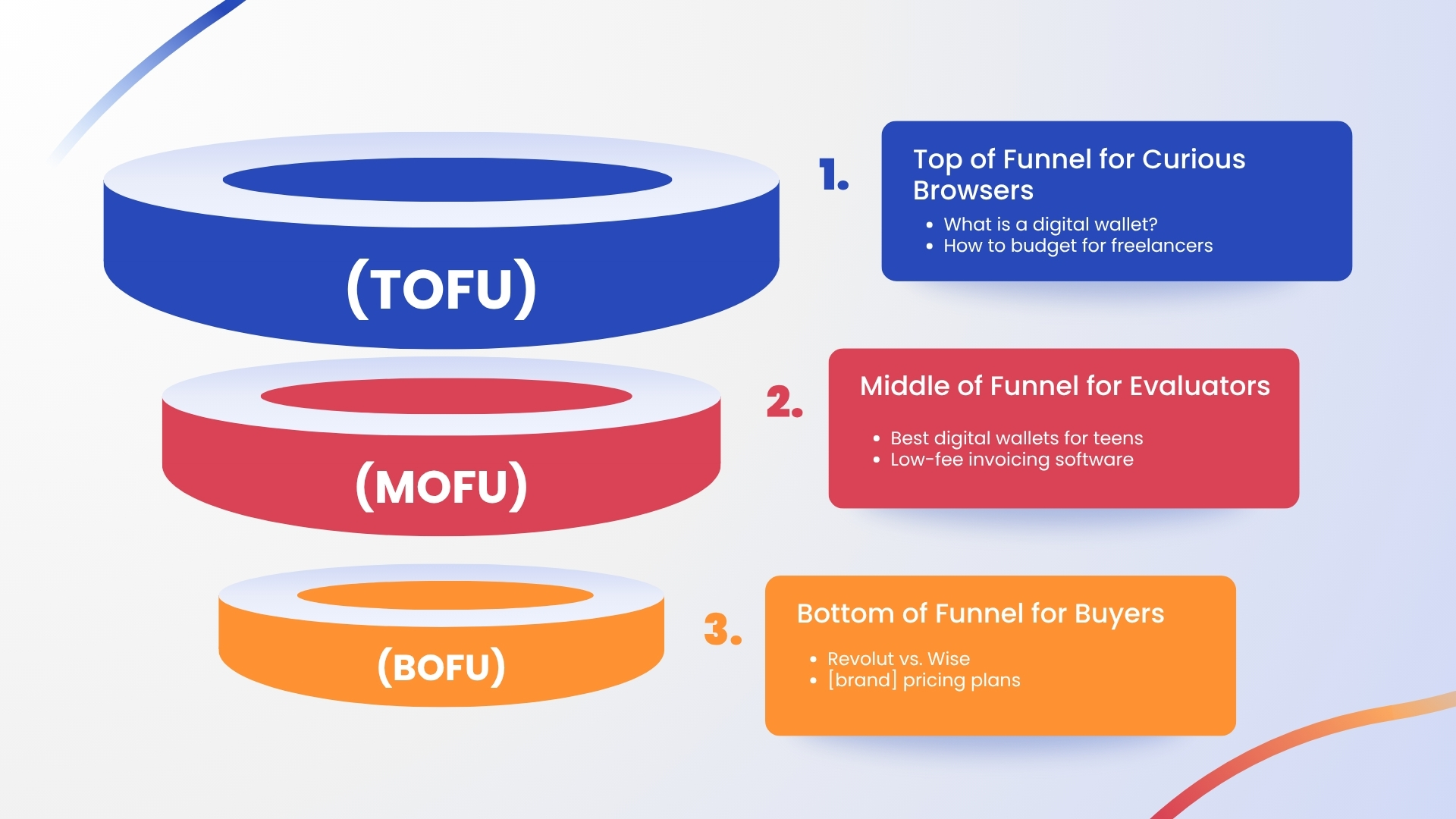
Build content for every stage, but never forget that BOFU keywords are the ones that are closest to generating revenue.
Apply Keywords to Content
A list of keywords isn’t enough. If they’re not connected to helpful, authoritative content, Google won’t take your site seriously.
That’s where content clusters come in.
Instead of writing standalone posts targeting random keywords like “ACH transfers” or “small business credit tips,” focus on building topic ecosystems. Google rewards sites that cover an entire subject in-depth and with structure.
Here’s how it works:
- Create a “pillar” page, a deep, comprehensive guide to a core topic you want to own.
- Support it with related blog posts that explore subtopics in detail.
- Interlink everything so users and search engines can easily navigate between them.
This approach helps Google understand your expertise, and it helps your readers go deeper, faster.
Let’s say you want to own the space around business financial automation. Your cluster might look like this:
| Pillar Page | Subtopics |
| The Complete Guide to Financial Automation for Small Businesses | • Best tools to automate invoicing
• How to reduce manual accounting errors • Zapier vs native integrations for expense tracking • Real-world ROI from financial automation |
Or maybe you’re targeting cross-border payments. That cluster could include:
| Pillar Page | Subtopics |
| How to Simplify International Payments in 2025 | • FX fees explained (and how to avoid them) • Wire transfers vs ACH: What’s faster?
• Top platforms for paying remote teams • Regulatory considerations for global payouts |
Each cluster makes your site easier to crawl, more authoritative, and more helpful for your audience.
Spy on Your Competitors
One of the fastest ways to spot high-impact SEO opportunities in fintech is to reverse-engineer what’s already working for your competitors.
Using Ahrefs, Semrush, and even plain old Google, you can uncover what’s driving traffic, links, and leads for your competitors and use those insights to build smarter and faster.
Here’s how to run a fintech-focused competitor content analysis:
Know Who You’re Really Up Against
Not all competitors wear the same jersey. In fintech, your competition tends to fall into three key buckets:
- Direct competitors: Other Fintech platforms solving the same problem (e.g., Ramp vs Brex, Chime vs Current).
- Legacy or manual solutions: The spreadsheet, the traditional bank, the accountant. If your target customer is “still doing it manually,” you’re competing with inertia.
- Topical authorities: Media sites, financial blogs, and comparison platforms (like NerdWallet or Investopedia) that dominate rankings, even if they don’t sell software.
Break Down Their Content Strategy
Competitor content is the breadcrumb trail you need to follow to reach sweet results. The trick is knowing what to look for.
Here’s some food for thought:
- Are they tailoring content to specific buyer personas or verticals? (Hint: If they’re targeting law firms, nonprofits, or solopreneurs, that’s your cue to niche up or find your own underserved segment.)
- Which pages drive the most traffic or backlinks? (Hint: Use Ahrefs’ “Top Pages” and “Best by Links” to spot patterns.)
- What content types are they using? Are they publishing “best budgeting apps” roundups, explainer guides, calculators, or templates?
- Is their content organized into hubs or clusters? Do they have pages tailored to specific audiences (freelancers, startups, CFOs) or by use case (invoicing, payroll, global payments)?
- What conversion tactics are they using? (Hint: Look for demo CTAs, calculators, product feature embeds, or personalized landing pages by intent stage.)
Pay attention to the patterns; there’s a reason they exist.
Study Their Link-Building Strategy
Backlinks matter, especially in competitive fintech niches. Understanding how competitors are earning them can help you build a smarter and leaner acquisition plan.
Check how quickly their referring domains are growing over time to determine their consistency. Collaborations and thought leadership pieces often pull in high-authority links, so be on the lookout for digital PR, expert roundups, or strategic content partnerships.
Also, check if they have a scalable link loop. Think community-driven content, partner pages, or integration directories that naturally attract backlinks over time.
Don’t Copy; Adapt and Outmaneuver
The goal isn’t to mirror what others are doing. It’s to spot the gaps, recognize what’s working, and tailor those tactics to your ideal customer profile.
Perhaps your competitor excels in templates, but they overlook international compliance content. That’s your window.
When you understand your competitors’ SEO playbook, you can write a better one for yourself.
Create EEAT-Focused Content
In fintech, trust is everything. It’s what Google categorizes as “Your Money or Your Life” (YMYL) topics. These take a great deal of trust and authority to rank.
That’s why every piece of content you publish should focus on building EEAT:
- Experience
- Expertise
- Authoritativeness
- Trustworthiness
These are the signals Google uses to assess whether your content is legitimate, especially in sensitive areas such as personal finance, banking, payments, and investing.
In other words, EEATing isn’t optional. It’s the foundation of ranking well and building customer confidence.
Here’s how to build EEAT in Fintech content marketing:
Show Lived Experience
If you’re publishing content about managing debt, saving for a home, or choosing a small business loan, Google (and your readers) want to know it’s coming from someone who’s actually been there.
Feature insights from real users, product specialists, or internal experts who work with customers daily.
Bring In True Subject Matter Experts
Finance is a high-stakes space. Interview CPAs, certified financial planners, fintech founders, or product leads. Use their quotes to add real credibility and to create content no AI tool or blog farm could replicate.
Build Authorship and Brand Authority
Include author bios with credentials. Link to press mentions, awards, or partnerships. Publish consistently on core topics to strengthen your reputation over time.
Google notices when your domain becomes a trusted voice in a niche.
Make Trust Visible
Trust is more than a feeling; it’s also what you show. These things matter:
- Customer reviews and testimonials
- Industry certifications or badges
- Transparent pricing pages
- Clear data privacy policies and security features
- HTTPS
Measuring SEO Performance for Fintech Brands
Sooner or later, someone in a suit (like your CFO, your board, or your investor) will lean in and ask:
“What’s the return on our SEO investment?”
It’s a fair question. In fintech, marketing budgets are lean, and SEO isn’t about vanity traffic. It’s about measurable business impact.
However, unlike paid channels, organic search doesn’t adhere to clean, short-term metrics. It’s long-game marketing. And it compounds.
Measuring fintech SEO ROI requires a smart approach that accounts for delays, attribution, and momentum over time.
Some ways you can measure SEO performance for fintech include:
- Align SEO goals with business outcomes. Are you driving traffic to a mortgage calculator? Converting CFOs to demo bookings? Boosting signups for a budgeting app? Define clear, trackable goals from the start.
- Track organic traffic and funnel activity. Use Google Analytics (or tools like Heap or Mixpanel for product-level insight) to monitor how organic users behave: pages viewed, time on site, conversion paths, etc.
- Attribute revenue to organic touchpoints. Assign values to key conversions like form fills, trials, or product signups. Use attribution models or CRM integrations (like HubSpot or Salesforce) to tie these to actual revenue.
- Track keyword and content performance. Use Ahrefs, Semrush, or SEOmonitor to monitor your rankings. Which terms are driving revenue? Are you climbing for high-intent Fintech keywords like “corporate card for startups” or “multi-currency business account”?
- Account for spending. Factor in costs such as content creation, tools, SEO agency or freelancer fees, and internal time. Compare the total investment to the pipeline and revenue influenced by organic search.
- Use ROI calculators to project forward. Tools like HubSpot’s Marketing ROI Calculator or custom cohort models can help forecast long-term returns, which is especially helpful for explaining results to leadership.
- Show before-and-after benchmarks. Highlight improvements in organic traffic, lead quality, and CAC over time. Bonus points for showing how SEO is reducing reliance on paid spend.
Good SEO is all about data. The right information can help fintechs know where to put their resources to optimize and improve.
Get Help with Fintech SEO from the Experts
Fintech SEO requires more than website security, blog writing, and target keywords. It’s about knowing how to put these SEO strategies together to achieve real business growth, not just higher search rankings.
Let our fintech SEO agency help you attract quality, targeted traffic with custom SEO strategies. Book a call today to learn more.
