



With new fintech tools, platforms, and products launching daily, online search results are more crowded than ever. If you want your brand to stand out, it pays to peek at what’s sending your competitors to the top of the SERPs.
An SEO competitor analysis helps you benchmark your SEO performance against others in your space. More importantly, it reveals your SEO strengths, weaknesses, and strategic blind spots, so you can build a roadmap that outpaces the market rather than just react to it.
Let’s break down how to run a fintech SEO competitor analysis and turn insights into trust, conversions, and long-term visibility.
TL;DR
- An SEO competitor analysis reveals which brands are ranking for your target keywords and where you can outperform them.
- Uncover gaps in keywords, backlinks, content quality, UX, and social engagement.
- Study competitors’ strengths and weaknesses across content and authority signals.
- Keep tracking rankings, traffic, backlinks, and SERP shifts to stay ahead.
Why Fintechs Need an SEO Competitor Analysis
Fintech is highly competitive, with neobanks, crypto platforms, lending apps, accounting tools, and myriad others vying for the same limited real estate: the top of the SERPs.
The stakes are high, given that 87% of consumers start their product search online, and fewer than 10% look beyond Google’s Page 1.
If you’re not ranking on Page 1 for your products or services, you’re missing out on clicks and conversions.
An SEO competitor analysis can change that.
Competitor analyses make your SEO strategy smarter by helping you understand what works, what gaps you can fill, and where you can outperform your competitors.
Done right, a competitor analysis gives you a backlog of high-impact, data-driven actions you can roll out over the next 6–12 months. It becomes a blueprint for building smarter content, targeting the right keywords, and earning backlinks that matter.
How to Conduct a Fintech SEO Competitor Analysis
Wherever you’re starting, the steps below will take you through how to run a sharp, focused SEO competitor analysis for your fintech business.
Find Your Top SEO Competitors
You likely know your direct competitors, the ones offering similar fintech products or services. But in SEO, your real rivals are the companies ranking for the keywords you want to rank for.
Those aren’t always the same names.
Here’s how to find them:
- Search like your customer: Plug your top keywords into Google (e.g., “small business invoice tool,” “crypto wallet for teens,” “best high-yield business savings account”). Don’t skip the ads as they show you who’s spending to dominate the space.
- Look at review sites: Platforms like G2, TrustRadius, and Capterra are goldmines. You’ll find which fintech tools are in your space, how they’re positioning themselves, and what real users are saying.
- Analyze SERP patterns: Who keeps showing up in the organic results? These are your keyword competitors, even if they’re not offering the same product.
Once you’ve gathered a shortlist of at least five strong competitors, drop them into a spreadsheet. Keep track of the brand names, website URLs, target product/service, keywords they rank for, and domain authority (use tools like Ahrefs or Semrush).
You’ll use this data to benchmark their strategy and find the gaps you can own.
Analyze Your Competitors’ Keywords
Run a keyword gap analysis to see the keywords competitors are ranking for, and you’re not.
In fintech, these are often high-intent terms tied to products, features, use cases, or trust-based search behavior.
Not every keyword matters here. These keywords need to be relevant to your product or service and fall under either commercial or transactional intent.
A few handy tools can surface these keywords easily:
Ahrefs Site Explorer
Plug in a competitor’s domain in Ahrefs to get a full list of organic keywords, estimated traffic, and ranking pages.
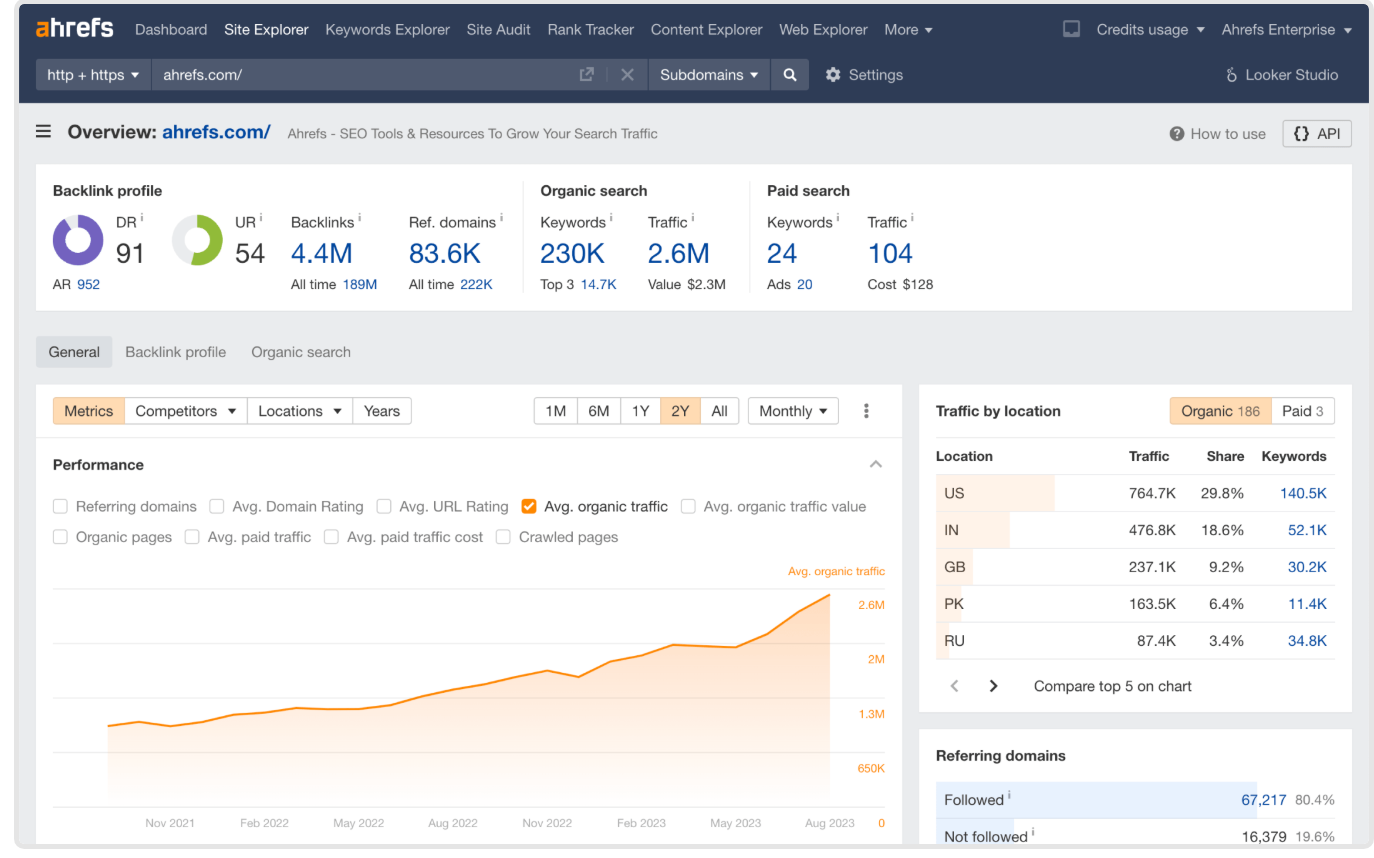
The Content Gap feature compares multiple competitors against your site to find missed opportunities.
Semrush Keyword Gap Tool
With Semrush, you can compare up to five domains and find unique keyword wins and overlaps.
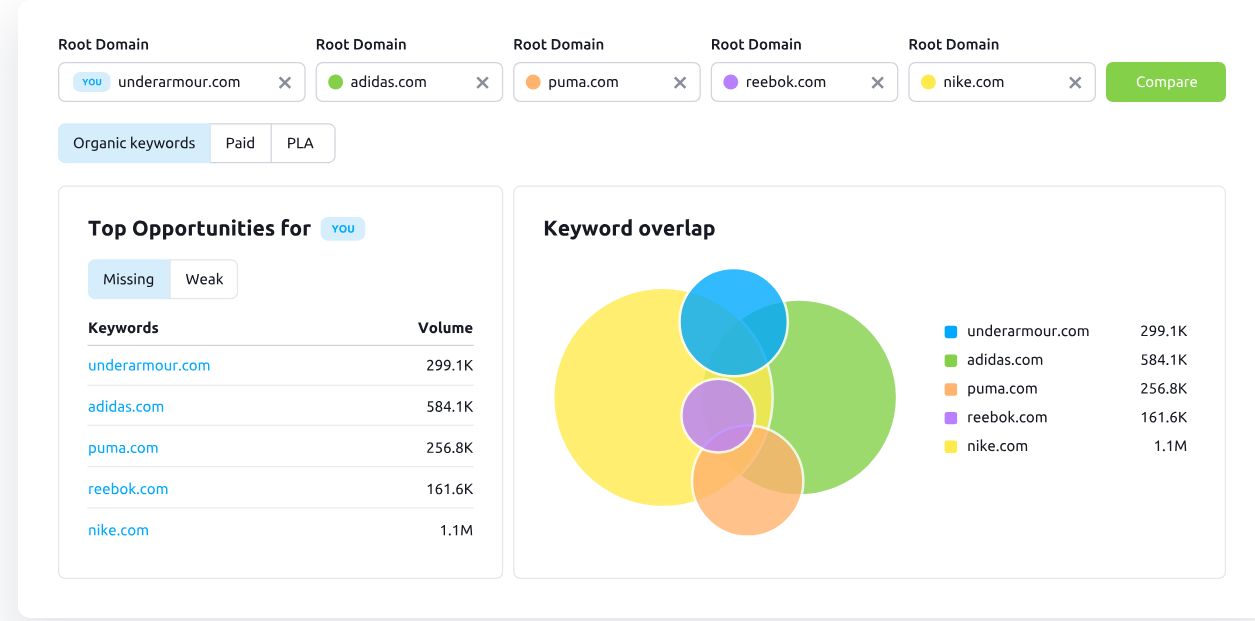
Use filters to zero in on high-volume, mid-difficulty keywords worth targeting.
Moz Keyword Explorer
The Keyword Explorer provides keyword suggestions, SERP analysis, and competitive keyword comparisons.
 This tool is especially helpful for identifying keyword intent and prioritization.
Ubersuggest
This entry-level keyword tool gives quick visibility into keyword performance, including estimated volume and difficulty.
It’s user-friendly, inexpensive compared to larger tools like Ahrefs and Semrush, and provides multiple data points for each keyword.
Answer the Public
This search listening tool from Ubersuggest captures question-based and long-tail keywords. See what real users are asking to surface the pain points your content can solve.
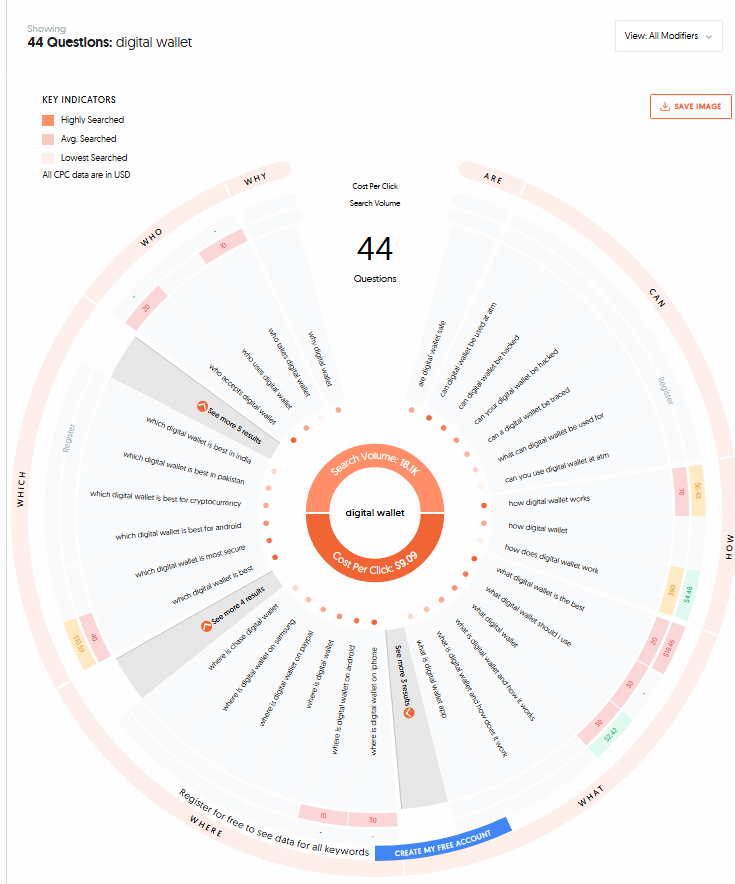
It spits out answers in an attractive graphic, separated by question type, showing key metrics such as cost per click, search volume, and difficulty.
Analyze Each Competitor’s Backlink Profile
Backlinks play a huge role in why competitors rank for certain keywords.
Backlinks signal trust and authority to search engines. They’re especially critical in industries dealing with money, regulation, and data security, where Google favors websites with strong reputation signals.
Your job at this stage is to find out who’s linking to your competitors and what types of content are earning those links.
This isn’t something you can DIY with Google. You’ll need the right tools.
Ahrefs Site Explorer
Drop in a competitor’s URL to see all referring domains, link types (dofollow/nofollow), anchor text, and top-linked pages.
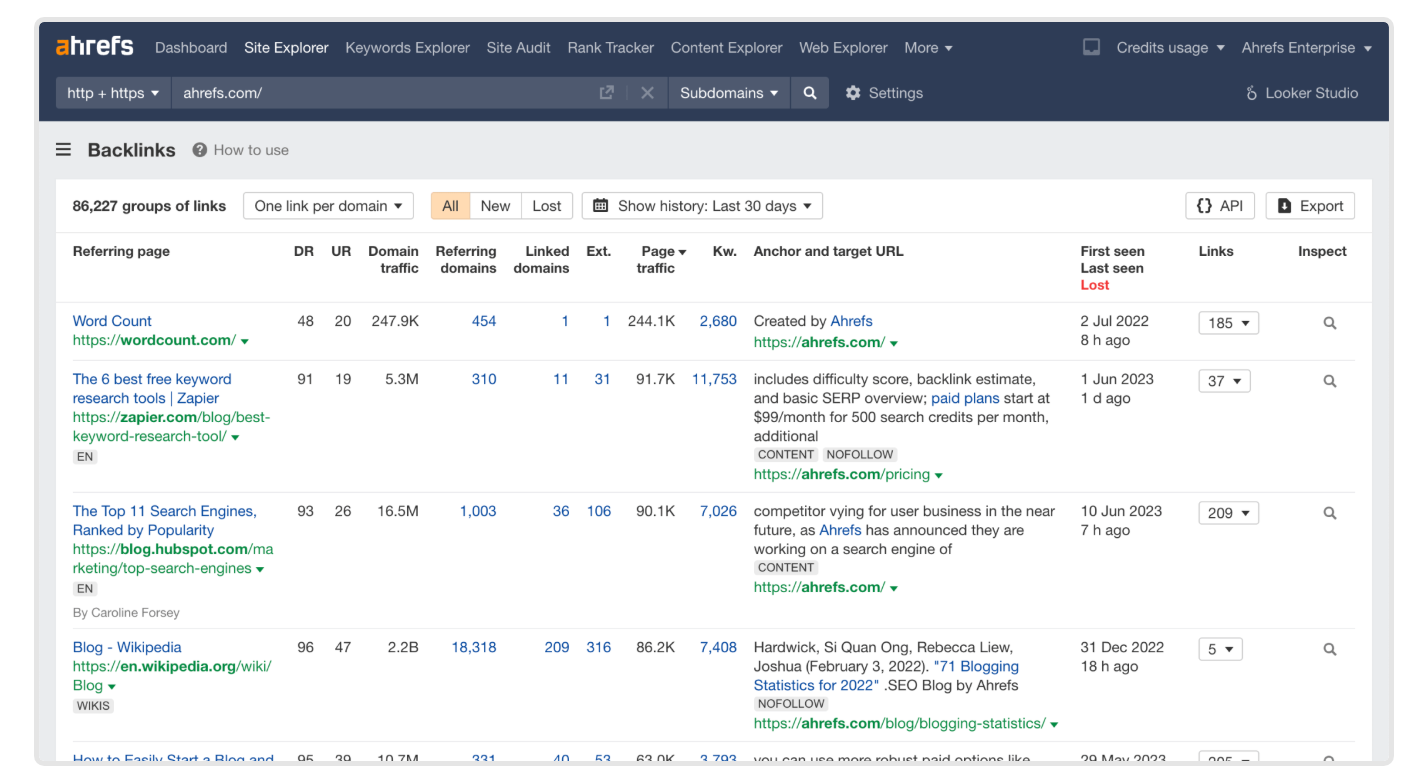
Use the Link Intersect feature to find domains linking to your competitors, but not to you.
Semrush Backlink Gap Tool
Compare up to five domains and quickly spot missing backlink opportunities.
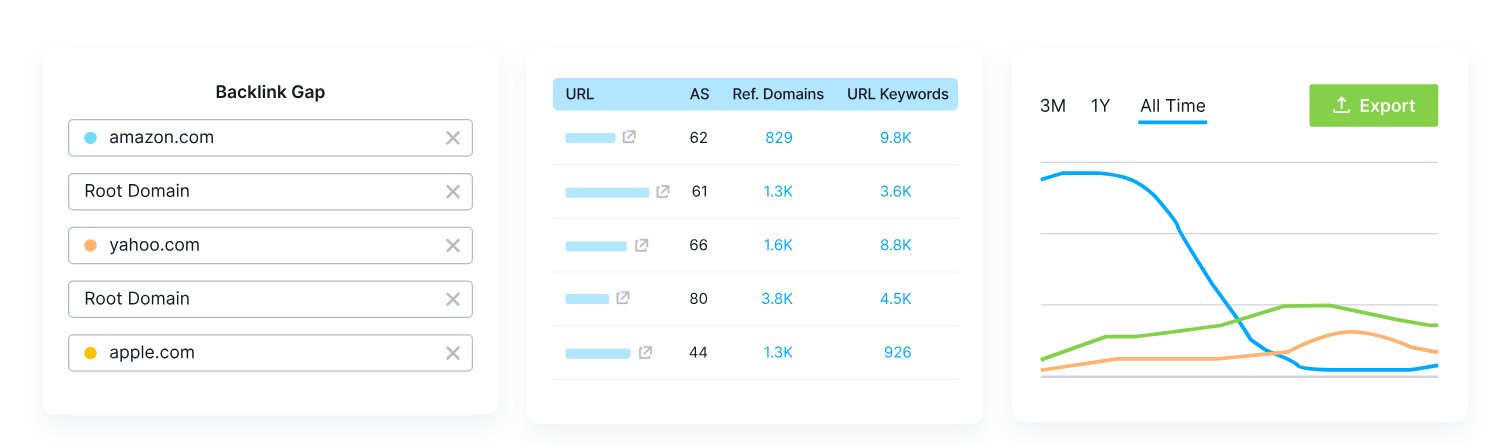
It also highlights the authority score of referring domains so you can prioritize your outreach.
Moz Link Explorer
This tool assesses link quality, page and domain authority, and top-performing pages by backlink count.
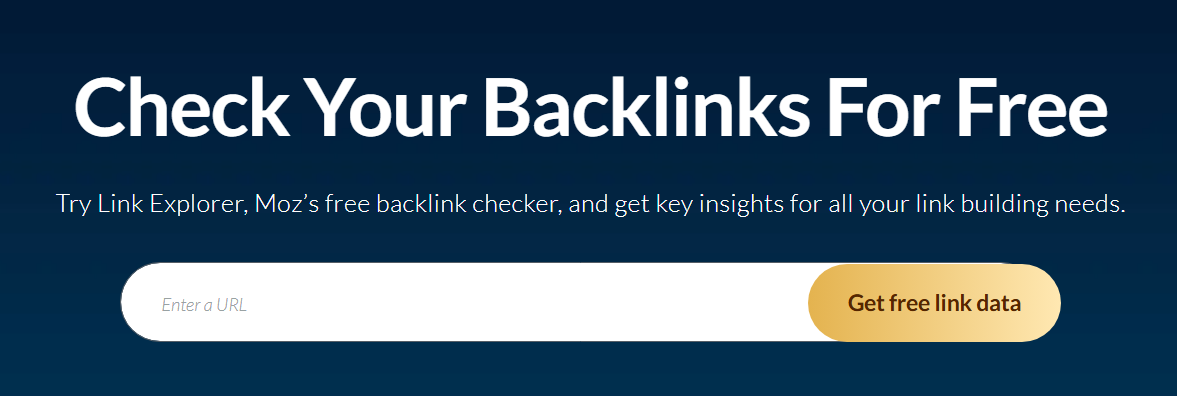
It’s also free to use (with limits).
Ubersuggest
This tool requires a little more manual comparison, but you can drop in any website URL to see a bounty of backlink data.

It tells you things like the number of backlinks, dofollow vs nofollow links, backlinks over time, referring domains, anchor text used, spam score, and more.
Peek at Your Competitors’ Content
Content anchors every SEO strategy. The quality, structure, and intent of your competitors’ content usually explain why they’re outranking you in the first place.
This step takes hands-on analysis.
Start by finding your competitors’ top-performing pages. You can use tools like Ahrefs or Semrush for this.
Then review the content manually:
- Is it structured well with clear headings, concise paragraphs, and good visuals?
- Does it answer a specific need?
- Is it educational, transactional, or product-led?
- Does it build trust through clarity, depth, or real-world examples?
- What type of language does it use?
Find these common denominators so you’ll know what to look for in your own content and how to fix it.
Pay Attention to Presentation
What your competitors say matters. How they present it matters just as much.
Google increasingly rewards sites that deliver a seamless, intuitive experience. That means technical SEO alone isn’t enough. User experience (UX) is now a core ranking factor and a major influence on conversion rates, especially in fintech, where clarity and trust are everything.
Fintech users expect a polished and secure experience. If your competitor’s site looks and feels more trustworthy than yours, they’re already winning the conversion.
Check Out Social Media Engagement
Social proof and audience engagement matter in SEO. Your competitors’ social media presence can reveal a lot about how they build trust, drive traffic, and maintain relevance.
Here’s what you should care about:
- Which platforms are they active on? LinkedIn is big in fintech, but some brands also drive traffic through Twitter, YouTube, or even Reddit.
- How often do they post? Check if they are launching new campaigns or just recycling content.
- What kind of content are they sharing? You’ll learn how they position themselves, depending on whether they use product updates, thought leadership, guides, or memes.
- Are they engaging? Confirm if they reply to comments, field questions, or respond to criticism, or if they feel automated.
- What’s the audience saying? Review sentiment, reactions, and the types of people interacting, whether that’s B2B decision-makers, SMB owners, or retail users.
Or, if you don’t want to spend time manually scoping out social media pages, tools like BuzzSumo and Hootsuite Streams can fill in the knowledge gaps:
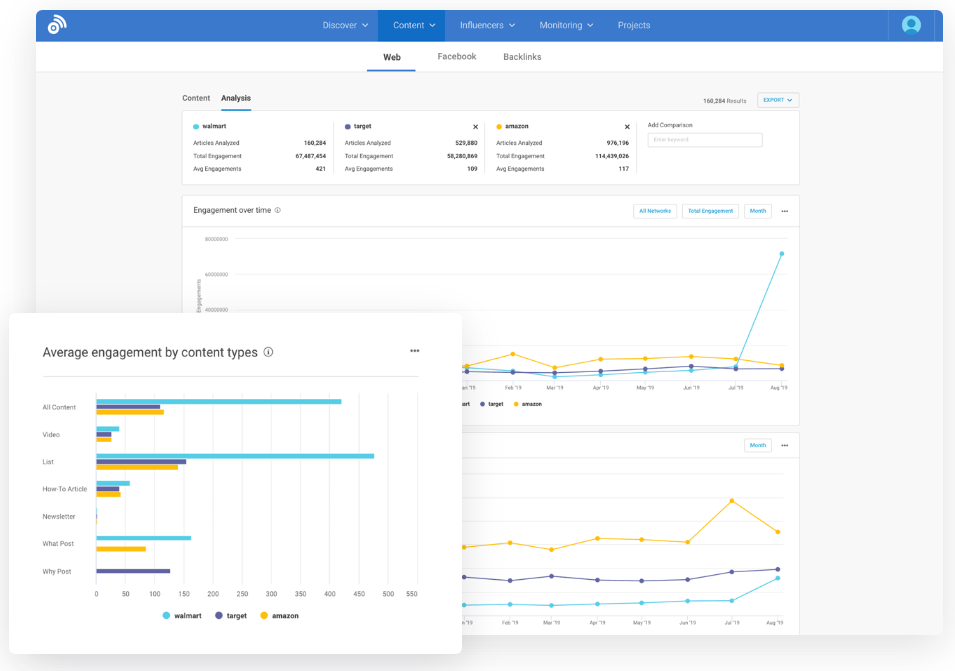
Use BuzzSumo to see which competitor content is getting the most shares, comments, and backlinks. Identify trends, track influencers, and find what’s driving engagement in your niche.
Use Hootsuite Streams to set up live tracking of competitors’ activity across LinkedIn, Twitter, Instagram, and other channels. Follow hashtags, monitor sentiment, and see how users are engaging in real time.
Social signals aren’t direct ranking factors. But they do amplify content reach, generate backlinks, and reinforce brand authority, and these absolutely influence SEO.
Try Out Your New SEO Strategy
Now it’s time to do something with all that data.
Don’t copy their playbook. Instead, build a smarter, leaner SEO strategy based on what’s already working in fintech.
Start by auditing your current strategy against what you’ve uncovered. For example, you could be missing keywords that your competitors dominate. Also, check if there are backlink opportunities they’ve earned that you haven’t pursued.
Then, update your roadmap. Prioritize filling keyword and content gaps and optimizing or replacing underperforming pages.
Competitor analysis is highly cost-efficient. Your competition has already validated what works. Use that insight to skip the guesswork, cut wasted ad spend, and fast-track your ranking goals.
Measure the Impact, Then Repeat
In fintech SEO, what works today might not work next quarter.
That’s why the final step is simple but critical. You need to track performance continuously, monitor your competitors regularly, and adjust fast.
Here’s what to keep an eye on:
- Keyword movement (yours and theirs)
- Page-level traffic and conversion rates
- Backlink growth
- SERP changes (new competitors, shifting rankings)
- Core Web Vitals and technical health
Use tools like Ahrefs, Semrush, and Google Search Console to keep your data live and actionable.
Need Fintech SEO Competitor Analysis Done Right?
In fintech, visibility breeds trust, and trust drives growth. When done right, competitor analysis reveals where you can grow and alerts you to threats before they hit, giving you the edge to outperform them.
If you need help with the nitty-gritty details, our team is here to help. Reach out to us today and let’s customize your strategy!
